Art's hidden topology
First-author paper · PLOS Computational Biology (2026) · open access · journal cover
As featured in Scientific American and on the PLOS Computational Biology May 2026 cover — cover figure and description by me.
The question, in plain terms
Why does a Kandinsky or a Rothko move people, while AI-generated art in the same style often leaves them cold? We asked whether there is a measurable difference between human abstract art and machine imitations — and whether people can feel it.
What we did
We treated each painting as a landscape of colour and used persistent homology (a tool from topology, the mathematics of shape) to measure the structure hidden in its contours — how regions and holes appear and merge as you sweep through the image. Then we compared people's responses to real art versus AI-generated look-alikes, both in a gallery and in the lab, using eye-tracking, EEG, and questionnaires.
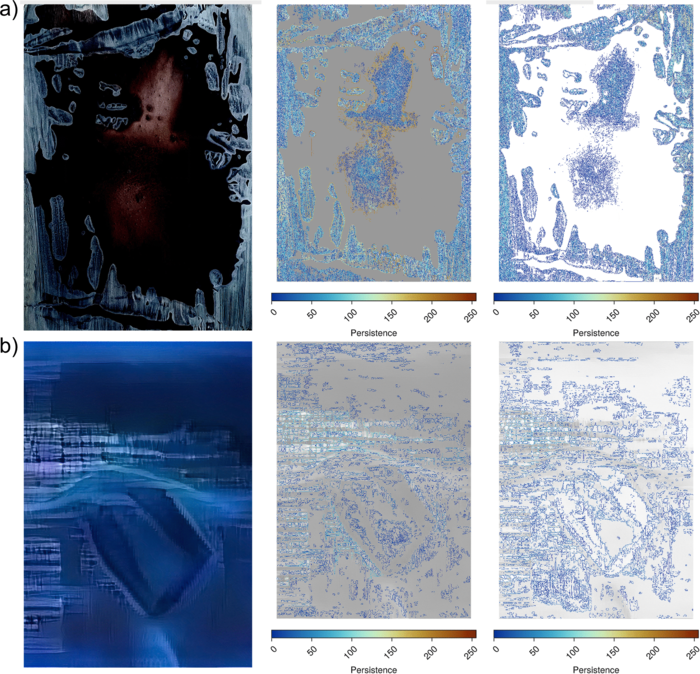
Each artwork is decomposed into layers of shape that persistent homology can pick out and quantify.
What we found — the "golden rule"
Human abstract artists — Kandinsky, Rothko, Malevich, Pollock, and others — all break a mathematical symmetry (Alexander duality) by a similar, characteristic amount. AI-generated art doesn't. That consistent "imperfection" is a fingerprint of human-made abstract art, and it tracks with how strongly viewers respond. A hard question about aesthetics turned into a number you can test.
My role
First author. I designed and ran the complete statistical analysis — the topological feature extraction, the comparison against AI-generated controls, and all the significance testing — and I authored the figure and description that ran on the journal's cover.
Links
Paper (open access): Art's hidden topology — A window into human perception, PLOS Comput. Biol. 22(5):e1014156
Press: Scientific American — "Golden rule in abstract art just discovered by mathematicians"
See also the visualization showcase for how these figures were built.