MesoSCOUT & topological data-analysis tooling
Open-source · Julia · first-author preprint (2025)
The problem
Large brain networks (and many other real-world networks) are usually compared by counting connections. But raw counts are dominated by a few very strong links and by whatever threshold you happened to pick — so genuine mesoscale structure, the mid-level organization between individual edges and the whole graph, gets washed out.
MesoSCOUT
MesoSCOUT reveals that mesoscale structure from the relative strength of connections rather than absolute counts, using a rank-based topological design (persistent homology on weighted networks). Because it is rank-based it is robust to the acquisition differences that normally make datasets impossible to compare directly — I demonstrated this by finding consistent structure across two independent cohorts (COBRE, N = 88; HCP).
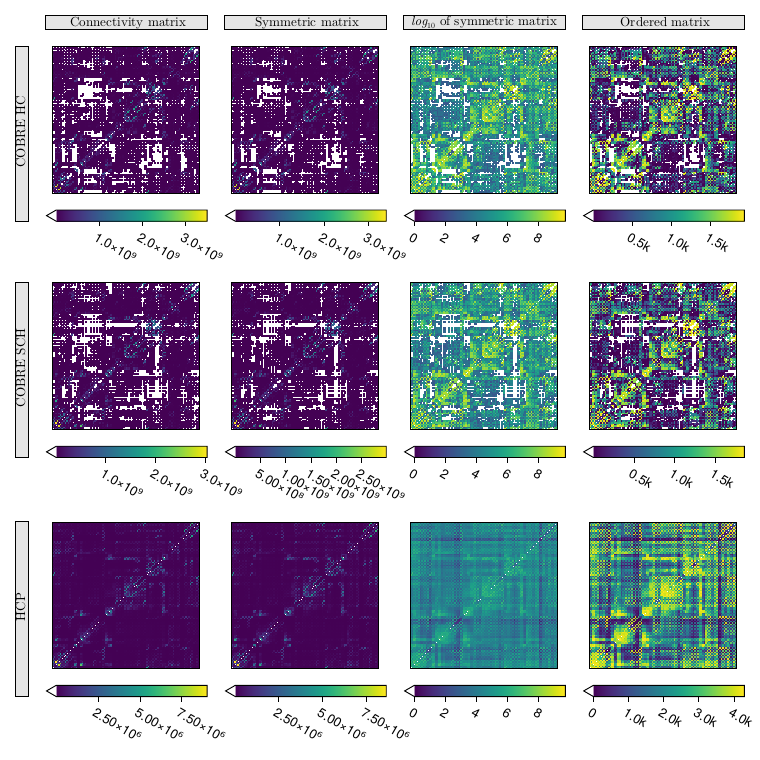
The same mesoscale structure recovered across independent datasets — see the visualization showcase for how these are built and read.
Engineering
The work is backed by reproducible analysis pipelines and a set of open-source Julia packages I authored for topological data analysis:
PersistenceLandscapes.jl — a Julia implementation of persistence landscapes (a translation and modernization of Paweł Dłotko's C++ implementation).
TopologyPreprocessing.jl — utilities for turning raw matrices into filtrations and extracting network properties through TDA.
SlidingWindowPersistence.jl — sliding-window persistence for time-series.
PersistenceImage — persistence-image computations.
These pipelines emphasize the engineering rigour I bring to research code: pure functions, memoization and algorithmic caching (a 10–15× speed-up over the original implementation), and reproducibility.
Related research
MesoSCOUT grew out of several years of first-authored conference work applying topology to brain connectivity and perception (OCNS 2020–2023). Those results are collected on the Publications page.
Links
Preprint (bioRxiv, 2025): MesoSCOUT: A novel tool for revealing mesoscale organization in the white-matter connectome — E. Dmitruk, C. Metzner, V. Steuber, S. Kadir. biorxiv.org/content/10.1101/2025.06.19.660631v3
All repositories: github.com/edd26